


Follow Batteries Plus


SLA Battery Guide: Choosing the Right Type for Your Application
Sealed Lead Acid (SLA) batteries are the silent workhorses of the commercial world. From keeping your emergency exit lights on to powering floor scrubbers and hospital carts, these batteries are essential. However, not all SLA batteries are created equal.
To get the most out of your budget, you must match the Battery Type to the Application. Here is why that distinction matters, and how to choose the right battery for your fleet.
The High Cost of the Wrong Battery
Why "It Fits" doesn't mean "It Works".
The most common error we see is putting a General Purpose battery into a Deep Cycle device (like a floor scrubber or mobility scooter) because the General Purpose battery is often cheaper.
The Consequence: While the battery will physically fit and power the device initially, inside the battery, a failure is already starting.
- Reduced Runtime: The battery will run out of power much faster than expected.
- Rapid Failure: General-purpose batteries have thin plates designed for standby use. Deep cycling them causes these plates to degrade instantly. A battery that should last 2 years might die in 2 months.
- Swelling & Safety: forcing a General Purpose battery to work this hard often causes it to overheat and swell, making it incredibly difficult and dangerous to remove from the equipment later.
The Rule: If the equipment has a motor or moves (scrubbers, scooters, lifts), you MUST use a Deep Cycle or Lithium battery.
What to Look for in an SLA Battery
We have categorized our top commercial options to help you balance budget against performance.
- Voltage (V) & Capacity (Ah): Voltage must match your equipment exactly (commonly 6V or 12V). Capacity (Amp Hours) represents the "gas tank" size. You can often upgrade Ah for longer runtime, provided the physical size remains the same.
- Dimensions: Always measure the Length, Width, and Height. SLA batteries are built to standard group sizes, but slight variations can prevent a battery from fitting into tight battery compartments.
- Chemistry:
- AGM (Absorbent Glass Mat): Spill-proof, maintenance-free, and vibration-resistant. The industry standard.
- Gel: Excellent for high heat and deep discharge, but sensitive to charging profiles.
- Lithium (LiFePO4): A newer technology alternative that is lightweight, fast-charging, and long-lasting.
Different Types of SLA Batteries
Not all Sealed Lead Acid batteries are created equal. While two batteries might look identical on the outside—same size, same shape, same voltage—the technology inside determines whether that battery will last five years or five weeks.
To help you choose the right power source for your specific equipment, we’ve broken down the four main commercial battery types available.
1. General Purpose AGM
The "Standby" Specialist
These batteries are designed for float applications. This means the battery spends 99% of its life fully charged, "standing by" for a power outage. They are built with thinner plates to maximize surface area for quick bursts of power, but they cannot handle being drained and recharged daily.
- Best Applications:
- Emergency Lighting & Exit Signs
- Security & Fire Alarms
- Gate Openers
- General Electronics
- The Advantage:
- Cost-Effective: The most budget-friendly option for equipment that rarely loses power.
- Reliable: Proven technology that holds a charge for long periods.
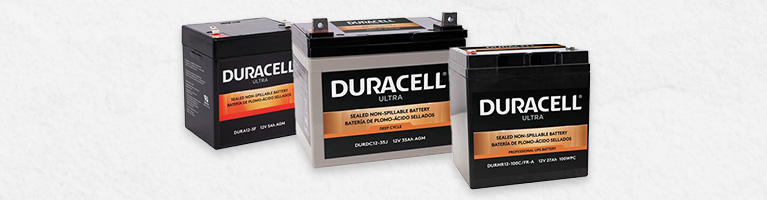
Product Spotlight: Duracell Ultra 12V General Purpose AGM
- Why we recommend it: When safety is on the line, brand trust matters. Duracell Ultra offers superior manufacturing consistency compared to generic alternatives, ensuring that your emergency lights and alarms activate exactly when you need them.
2. Deep Cycle AGM & Gel
The "Daily Driver" Workhorse
Unlike general-purpose batteries, deep-cycle batteries are built with thicker lead plates. This construction allows them to withstand the stress of being discharged (drained) and recharged repeatedly.
- Best Applications:
- Floor Scrubbers & Sweepers
- Electric Wheelchairs & Mobility Scooters
- Medical Carts & Patient Lifts
- Solar Energy Storage
- The Advantage:
- Durability: Can withstand hundreds of discharge/recharge cycles.
- Vibration Resistance: Thicker plates are less likely to break under the vibration of a moving machine.
Product Spotlight: Duracell Ultra 12V 35AH Deep Cycle AGM Battery
- Why we love it: Designed specifically for heavy cycling. This battery resists vibration and provides consistent power delivery for mobility and cleaning equipment.
Product Spotlight: Duracell Ultra 12V 50AH GEL Battery
- Why we love it: The Gel electrolyte is more resistant to extreme temperatures and deep discharges, making it ideal for demanding environments where standard AGM might fail prematurely.
3. High Rate UPS
The Critical Power Protector
Data centers and server rooms have unique needs. They don't need a battery to run for hours; they need a battery that can dump massive amounts of power in minutes to keep servers running until the generator kicks in. High Rate batteries are specialized for this exact purpose.
- Best Applications:
- Uninterruptible Power Supplies (UPS)
- Data Centers/Server Rooms
- Medical Equipment
- Telecom Backup Systems
- The Advantage:
- High Power Density: Designed to discharge a lot of energy very quickly without voltage drop.
- Flame Retardant: Many high-rate options come with flame-retardant cases for compliance in server rooms.
Product Spotlight: Duracell Ultra 12V High Rate UPS Battery
- Why we recommend it: Featuring flame-retardant casing options and high-density plate construction, these batteries ensure your critical data is protected during those crucial first minutes of an outage.
4. Lithium Iron Phosphate (LiFePO4)
The "Best" Performance Upgrade
If you want to move beyond the limitations of lead-acid entirely, Lithium (LiFePO4) is the ultimate upgrade. While they fit in the same physical slots as SLA batteries, they offer performance that changes how you operate.
- Best Applications:
- High-Use Floor Care: Machines that run multiple shifts a day.
- Medical Carts: Where weight and fast charging are vital for nurses.
- Remote Monitoring: Equipment in hard-to-reach places (cell towers, signage).
- The Advantages:
- 10x Longer Life: Lasts 2,000–5,000 cycles compared to 300–500 for lead-acid.
- Fast Charging: Charge in 1-2 hours vs. 8-10 hours for lead-acid.
- Lightweight: Weighs 50% less, reducing wear on equipment motors and preventing injury during installation.
Product Spotlight: X2Power Lithium Iron Phosphate (LiFePO4)
- Why we recommend it: It transforms your workflow. With 10x longer life, 4x faster charging, and 50% less weight, X2Power is the premier choice for businesses looking to drastically reduce maintenance costs and truck rolls over the long term.
The Critical Detail: Matching Your Terminals
It is a common misconception that if the voltage and physical size match, the battery will work. This is not always true.
Nothing causes more headaches for maintenance teams than arriving at a job site with a fresh battery, only to find the connectors on the equipment don't fit the terminals on the battery. Attempting to splice wires or force connections can be dangerous and may void equipment warranties.
Common terminal types to look for include:
- F1 vs. F2 Faston Tabs: These are the most common terminals for smaller batteries (used in alarm systems and UPS units). They look nearly identical but are different sizes.
- F1: The narrower version (approx. 3/16" wide).
- F2: The wider version (approx. 1/4" wide).
- Note: If you order an F1 battery for an F2 wire, the connection will be loose and dangerous. Always verify which tab size your equipment requires.
- Nut & Bolt (NB): Common on larger capacity batteries (9Ah - 100Ah). These feature a square post with a hole for a bolt to pass through.
- Insert (Threaded): Often found on UPS batteries and larger cycling batteries, these allow a bolt to be screwed directly into the battery casing, which is great for tight spaces where protruding posts would get in the way.
- J and P Terminals: Typically found on larger deep-cycle batteries (30Ah+). While they look similar to standard Nut & Bolt terminals, they are often wider or thicker to handle higher current loads. Always check if your cables require these specific heavy-duty terminals.
The Bottom Line: Before you click "order" or head to the store, physically look at the old battery's connection points to ensure a seamless swap.
Unlock Exclusive Benefits with a Business Account
Managing power for an entire facility or fleet is complex. We make it simple. When you partner with us, you aren't just buying batteries; you are gaining a dedicated support team.
By signing up for a free Batteries Plus Business account, you gain access to a suite of tools and perks designed to save your organization time and money:
- Competitive Volume Pricing: Get the best rates on the products you use most.
- Dedicated Account Representative: A single point of contact who understands your specific industry needs.
- Free On-Site Needs Assessment: We can come to you to audit your equipment and suggest efficiencies.
- Recycling Services: We handle the regulatory burden of disposing of your old batteries and bulbs.
- Fast Local Delivery: Get what you need, when you need it, often same-day.
- Free Battery Testing: Don't replace good batteries; let us test them first.
- Tailored Service Options: Custom solutions that fit your workflow.
Don't pay retail prices for commercial needs. Join the thousands of businesses that trust us to keep them running.
Power Your Business with Confidence
Choosing the right battery isn't just about the price tag; it's about Total Cost of Ownership. A "Good" battery is perfect for an exit sign, but a "Best" battery is essential for a floor scrubber that runs 4 hours a day.
Our commercial team is ready to help you audit your equipment and find the perfect match. From bulk pricing to recycling your old lead-acid cores, we are your full-service power partner.
Ready to upgrade your fleet? Stop guessing and start powering.
Frequently Asked Questions
While both are sealed lead acid, they use different electrolytes. AGM (Absorbed Glass Mat) is the industry standard for most standby and cycling applications because it handles high currents well and is cost-effective. Gel batteries use a silica-gel electrolyte that is more resistant to vibration, extreme heat, and deep discharge damage, but they are more sensitive to charging voltage. Use Gel for tough environments, but always check your charger compatibility first.
You can, but it's not optimized for it. A high-rate battery will give you more runtime during a high-load outage. Conversely, using a UPS battery in a deep-cycle application (like a scooter) will kill the battery very quickly.
It comes down to "Total Cost of Ownership." You might buy 5 lead-acid batteries over a 5-year period, paying for labor to swap them each time. Or, you could buy 1 Lithium battery that lasts the whole 5 years with zero maintenance.
Swelling is typically caused by overcharging or misuse—most commonly using a General Purpose battery in a Deep Cycle application. The battery overheats, gas builds up, and the case expands. Remove it from service immediately.
Yes. We offer robust recycling programs for businesses, ensuring your old lead-acid batteries are disposed of in full compliance with environmental regulations.